
IN PRACTICE
Sometimes the question changes.

The work often starts with one question.
What we find determines where it goes next.
01 · IN PRACTICE
It looked like
one problem.
Looking closer revealed something else underneath it.
THE QUESTION
Who are the right companies —
and who should we talk to?
It started with a list.
Find the right companies. Identify the right people. Give the commercial team somewhere to start.
COMPANY | MARKET | INDUSTRY | FUNCTION | TITLE | STATUS |
|---|---|---|---|---|---|
Eastpoint Systems | Singapore | Enterprise Technology | IT | CIO | Contacted |
Bayan Consumer Group | Philippines | Consumer | Procurement | Head of Procurement | Research |
Mekong Industrial | Vietnam | Manufacturing | Procurement | Procurement Lead | Verified |
Straits Commerce | Malaysia | Distribution | Commercial | Commercial Director | Contacted |
Pacifica Retail Group | Philippines | Retail | Finance | Finance Director | Verified |
Northbridge Foods | Thailand | F&B | Operations | Regional Operations Director | Contacted |
Aruna Systems | Indonesia | Technology | IT | IT Manager | Verified |
Meridian Cloudworks | Singapore | Technology | IT | IT Director | Research |
The list wasn't the intelligence.
The conversations were.


THEN WE STARTED TALKING TO PEOPLE.
A name and a title
only tell you so much.
COMPANY
TITLE(ON PAPER)
BUT ACTUALLY....


Eastpoint Systems
CIO


Bayan Consumer Group
Head of Procurement

Procurement Lead
Mekong Industrial

Commercial Director
Straits Commerce

Pacifica Retail Group
Finance Director

Regional Operations Director
Northbridge Foods

IT Manager
Aruna Systems

IT Director
Meridian Cloudworks
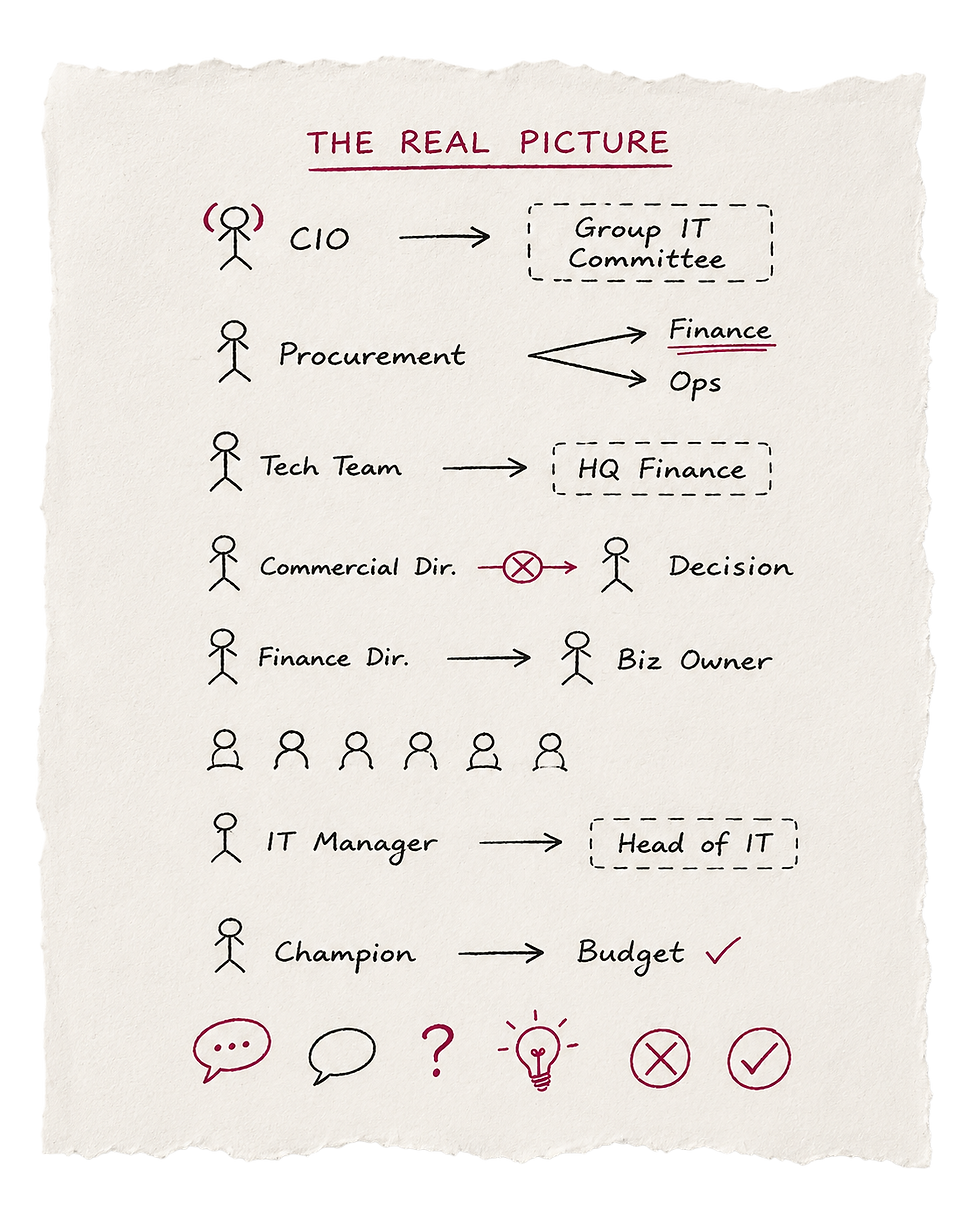
Does he actually decide?
Are they choosing, approving, or just processing?
WHat did he say?
Who appoves the budget?
Who else is involved?
Who's the real owner of this problem?
What's the context behind this mandate?
WHAT WE FOUND OUT
-
Influencer, not final decision maker
-
IT roadmap decided at group level
-
Procurement executes
-
Final call with Finance + Ops
-
Technical team only
-
Budget controlled by HQ
-
Wants to change, internally blocked
-
Legal and group buy-in needed
-
Budget in FY budget cycle (Q4)
-
Finance +Business Owner decide
-
4 stakeholders involved
-
Ops pain > IT priority
-
Not the budget owner
-
Reports to Head of IT
-
Champion strong
-
Budget approved, waiting vendor
On paper, it looks simple
Reality is messy.
WAIT.
This is where it gets interesting.

THEN WE STARTED TALKING TO PEOPLE.
A name and a title
only tell you so much.
Different companies.
Different industries.
Same themes.
Buying Behaviour
How does a decision actually happen?
-
Often starts with a problem, not a product
-
Multiple stakeholders
-
Internal alignments take time
Authority
Who influences it?
Who approves it?
-
Users, not always the final decisional maker
-
Cross-functional input
-
Finance, legal, IT, ops, all have a say
Budget
Where does it sit?
When does it become available?
-
Often in annual cycle
-
Depends on business priority
-
Sometimes already allocated, somtimes need a case
Current Solutions
What's already there — and why?
-
Existing tools often "good enough"
-
Change is hard (people, proxess, cost)
-
Multiple tools used across teams
Friction
What's making the current situation difficult?
-
Lack of visibility
-
Manual processes
-
Security / compliance concerns
-
People working around systems
Timing
Why now?
Why not yet?
-
Triggered by growth, restructuring, or a pain point
-
Sometimes reactive (e.g. incident)
-
Sometimes part of a longer-term plan
Movement
What changed?
Who moved?
What triggered it?
-
New leadership
-
Internal champion
-
External pressure (e.g. audit, regulation)
-
Clear business case
Outcomes
What happened next?
-
Approved and moving forward
-
Put on hold (for now)
-
Narrower initial scope
-
New stakeholders involved
-
Clearer next steps
Same problems.
Different contexts.
Different journeys.
Same underlying logic.
Oh. There's a pattern.
LOOK AGAIN.
You just have to know what to listen for.
A market starts to tell you
how it actually works.
Less assumptions.
More understanding.
02 · IN PRACTICE
This time, the question wasn't the problem.
The mandate was clear. Making all the pieces move together was the work.
CAMPAIGN/ EVENT
THE BRIEF
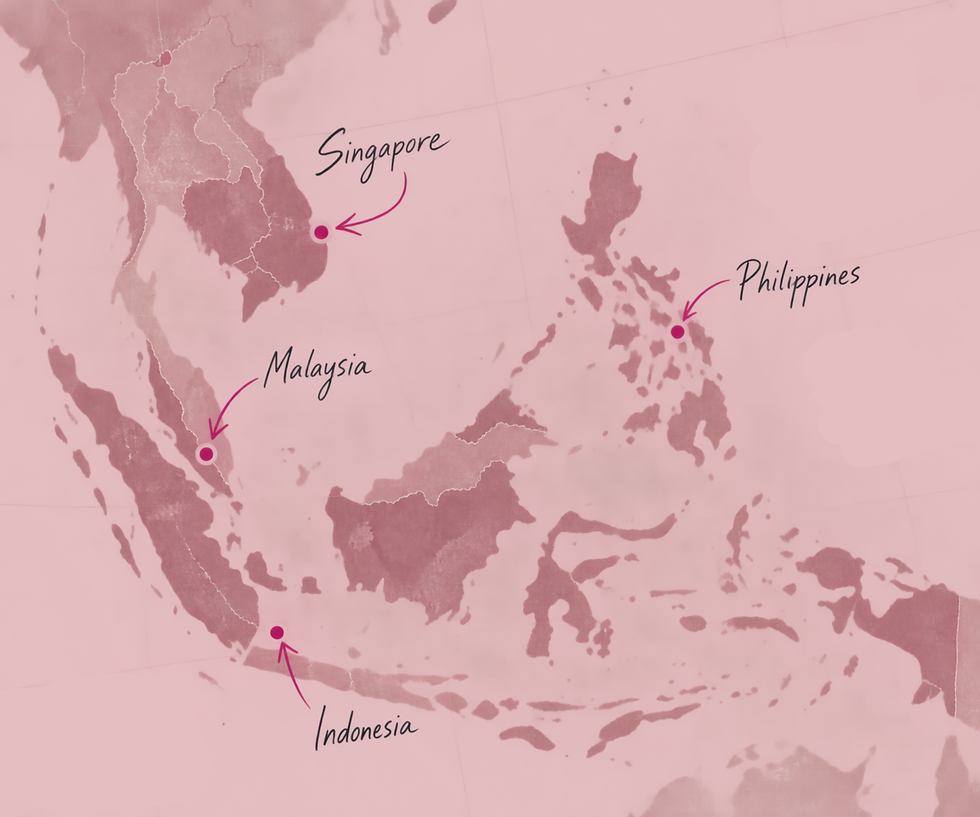
Make it happen across four markets.
Indonesia · Singapore · Philippines · Malaysia



Data
A LOT HAD COME TOGETHER
Messaging
Logistics
Audience
Handover
Who owns this?
Waiting on what?
Who needs to know?
What happens next?
Local context
Confirmations
Stakeholders
THE WORK
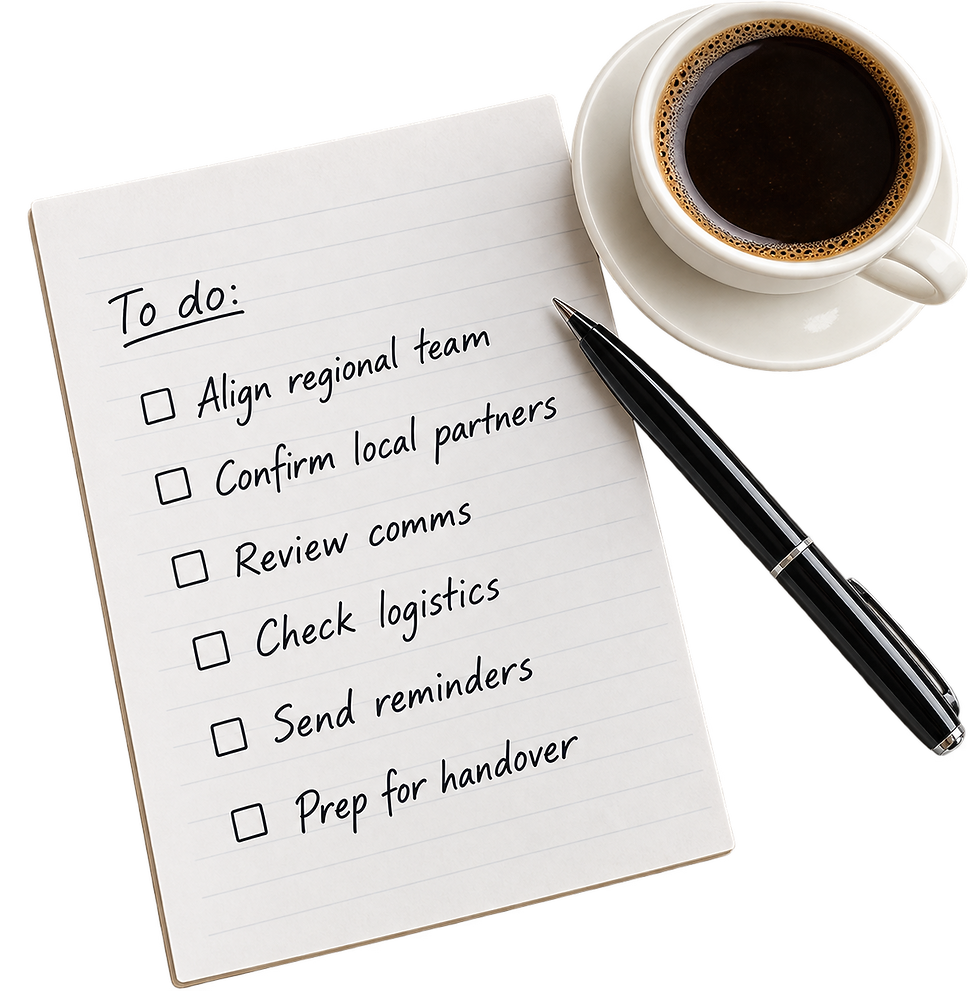
Everybody had a piece.
Somebody had to hold the whole thing.
Regional team
Objectives / Assets / Reporting
Commercial team
Target accounts / Follow-up
Attendees
Invitations / Confirmations / Reminders
Operations
Venue / Logistics / Timing
Different people.
One outcome.
Responsibilities / Handovers
Partners
Audience / Context / Outreach
Local market
Outreach
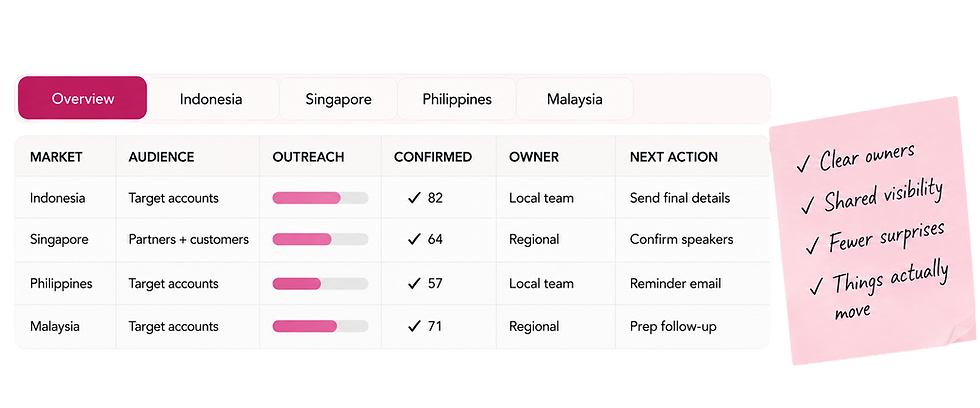
MAKE IT VISIBLE
If everyone knows what's happening,
the work can move.
A simple way to keep complex things on track.
AND THEN?
It moved.
Four markets.
Different teams.
A lot of moving pieces.
One coordinated execution.
4
markets
Aligned
stakeholders
On-ground
execution
03 · IN PRACTICE
One problem kept
turning into another.
Because they weren't separate problems.

BRAND?
01. IT STARTED HERE.
Make the brand sexy.
An established consumer brand wanted to move upmarket — more desirable, more culturally relevant, and more credible in the rooms it wanted to enter.

02. SO WE LOOKED AT THE BRAND
Attention wasn't
the same as desire.

DISTRIBUTION
Already strong.

PERCEPTION
Didn't match the ambition.

PRICE
Accessible.

VISIBILITY
Already spending for attention.
more≠ better
there.
03. LOOK CLOSER.
The brand wasn't the only one talking.

FOUNDER
How does he/she show up?
BRAND
PERCEPTION
What does all of this signal?
PRODUCT
What world are we actually building?
TEAM
Who makes things move?
CULTURE
What's the normal here?
PARTNERSHIPS
Where does the company belong?
SYSTEMS
Where does the work live?
Oh.
04. SOME THINGS NEEDED SAYING
The standard isn't
what you ask for.
It's what you allow.
TIME
When repeated delays are accepted,
delay becomes normal.
OWNERSHIP
When nobody owns the next move,
people learn to wait.
DEPENDENCY
When the founder has to push everything forward,
the company learns to depend on the founder.
Someone has to say it.
05. THE PROBLEM BEHIND THE PROBLEM.
You can't market your way
around how the business works.
01
BRAND
Build a world people want to belong to.
02
PRODUCT
Give that world something credible to grow around.
03
FOUNDER
Make the person behind it part of the story.
04
RELATIONSHIPS
Put the company in the right rooms.
05
TEAM
Move from waiting to ownership.
06
SYSTEMS
Make the work visible.
07
EXECUTION
Make the new standard real.
06. SO THE WORK EXPANDED.
One ambition.
A lot underneath it.
One thing
leads to another
and another
it's connected
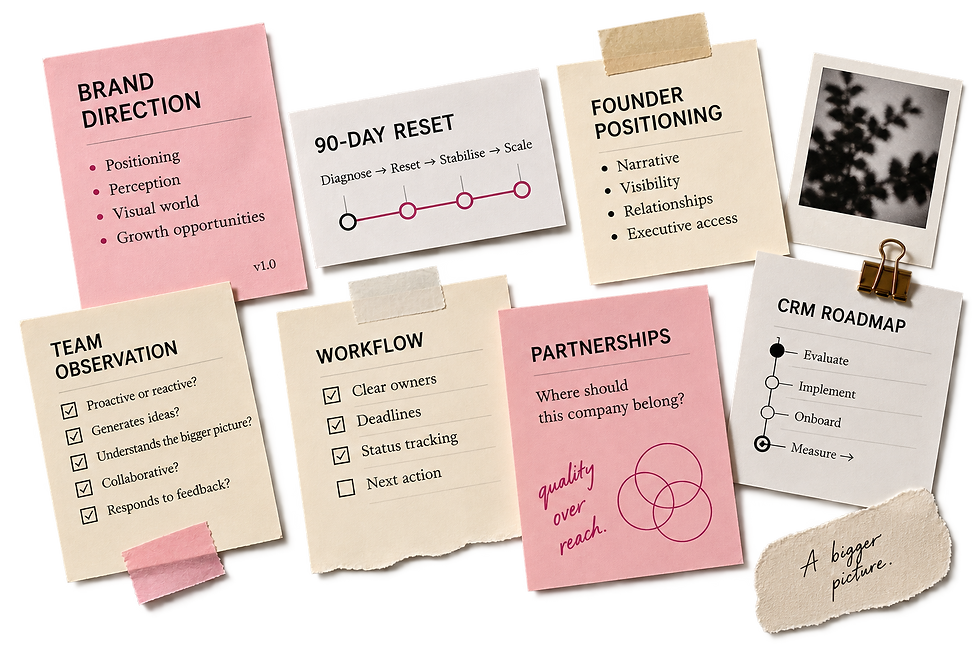
07. FROM THE WORK.
Then we built
what the idea needed.
08. WHAT HAPPENED NEXT.
Two months later,
we sat down again.
A lot had changed.
The team had been restructured.
The brand had been revamped.
A new brand story had taken shape.
Nine hours of updates later...
okay. get to the bad part.
04 · IN PRACTICE
It started
with leads.
It didn't stay there.
THE ASK
get the right people in the room
01. IT STARTED HERE.
Get the right people
in the room.
Digital fatigue was setting in. The usual channels weren’t creating enough engagement.
The job was simple: find the right audience, reach them, and get them to show up.
FIND → REACH → ENGAGE → CONFIRM → SHOW UP
Starts here.
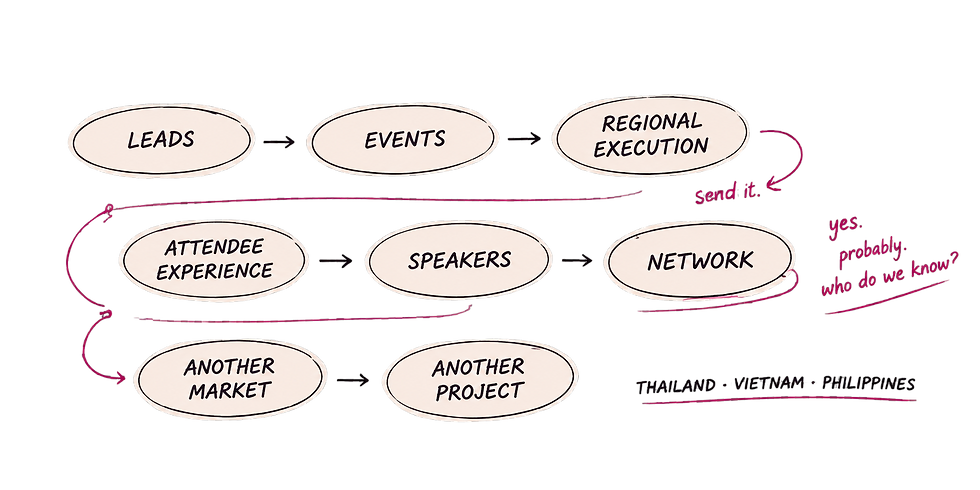
02. ONE PROJECT BECAME ANOTHER.
And another.
And another.
What started as a single project turned into a series.
More than a year. Several different projects.
oh.
we're still here
PROJECT → PROJECT → PROJECT → PROJECT → ...........
01 02 03 04
03. THE ROOM GOT BIGGER.
Literally.
Together, we helped pull off one of their largest virtual summits in Southeast Asia.

um.
more chairs?
04. THE ASK KEPT CHANGING.
Can you also…?
As trust grew, so did the scope. What started with leads expanded into new work across markets, people and opportunities.
05. SOMEWHERE ALONG THE WAY.
The language changed.
GO-TO
That’s what they started calling us.
06. THE RELATIONSHIP CHANGED TOO.
Vendor.
- deliver → again → another ask → another market → trust →
Partner.
06. AND THEN TIME PASSED.
The logos changed.
The relationships didn’t.
ONE MOVED ON
ONE MOVED UP
Role
Bigger role
Company A
Company B
He changed companies.
The next time there was an opportunity to work together, he reached out again.
She grew into a more senior role.
When we later launched something new in Singapore, she was there.
TRUST TRAVELS